Moving to Spain? ¡Enhorabuena! (Congratulations!)
As much as you might think that your GCSE Spanish or Duolingo streak has got you covered, there’s a whole world of Spanish phrases that don’t quite translate into the Queen’s English.
Remember, language is the key to truly immersing yourself in Spanish culture. While learning these phrases is a great start, you might find yourself needing more comprehensive language support as you settle into your new life.
From translating official documents like will translation for example, to localising your business materials, professional translation services can be invaluable for communicating clearly in your new home.
GOV.UK guidance for British nationals living in Spain says:
To work in Spain, you may need a work permit or work visa.
Source: GOV.UK, Living in Spain, checked November 2026
To help you avoid looking like a deer in headlights or worse, a tourist asking for “uno cerveza, por favor”, here are 10 common Spanish phrases you’ll want to master before making the big move.
In short
- Ten common Spanish phrases follow, each with its literal translation and English equivalent.
- Several are idioms that do not translate directly into English.
- A short list of Spanish words to listen out for in daily conversation appears at the end.
- A free PDF of key Spanish phrases is available to download.
- Professional translation services can help with official documents and business materials.
Spanish phrases to know:
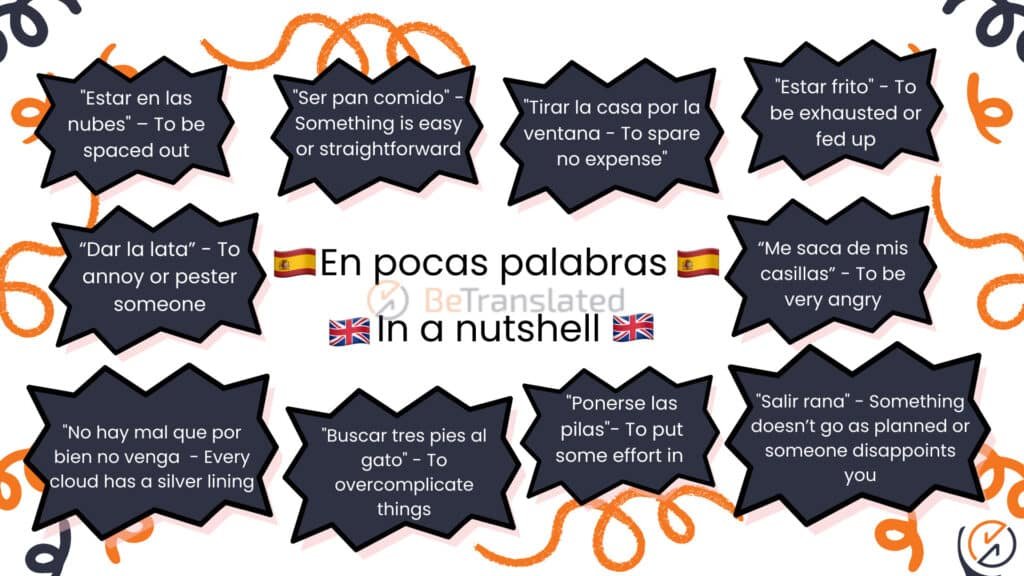
“Estar en las nubes”
- Literal translation: To be in the clouds
- English equivalent: ‘Head in the clouds’
If someone says you’re “en las nubes,” they’re politely suggesting that you’re a bit spaced out. Think of it as the Spanish version of “head in the clouds.” Perfect for when you’ve been daydreaming about sipping sangria on the Costa del Sol instead of listening to someone’s detailed description of the local tax regulations.
“Dar la lata”
- Literal translation: To give the can
- English equivalent: ‘To be a pain in the neck’
This might sound like you’re handing over a tin of baked beans, but it actually means to annoy or pester someone. If you’re repeatedly asking your neighbour to stop playing reggaeton at 3 a.m., they might just say you’re “dando la lata.” Don’t worry though; they’ll still invite you to the next barbecue.
“No hay mal que por bien no venga”
- Literal translation: There’s no bad from which good doesn’t come
- English equivalent: ‘Every cloud has a silver lining’
This phrase is a reminder that even bad situations can bring positive outcomes. If you’ve just lost your job and are feeling down, someone might tell you “no hay mal que por bien no venga.”
Who knows? You might end up landing a dream job or discovering a new passion. It may seem like a tongue twister at first, but after a few tries, you’ll be dishing out optimism like a pro.
“Ponerse las pilas”
- Literal translation: Put in your batteries
- English equivalent: ‘Put your back into it’
No, this isn’t about swapping out your TV remote batteries. When someone tells you to “ponte las pilas,” they’re telling you to get your act together and put some effort in. It’s especially useful when your Spanish friends finally drag you to a flamenco class, and you’ve been standing in the back pretending to know the steps.
“Ser pan comido”
- Literal translation: It’s bread eaten
- English equivalent: “A piece of cake’
In English, we might say “piece of cake,” but in Spain, it’s all about bread. When something is “pan comido,” it means it’s easy or straightforward. So, the next time you finally manage to park your car in a tiny Spanish parking spot, you can proudly say it was “pan comido” (even if it took five attempts).
“Tirar la casa por la ventana”
- Literal translation: Throw the house out the window
- English equivalent: ‘To go all out’
While this may sound like something that happens at the end of a particularly bad house party, it actually means to spare no expense. If you decide to celebrate your new life in Spain with an elaborate fiesta, you’ll be “tirando la casa por la ventana.” Just make sure you don’t actually toss any furniture out.
“Me saca de mis casillas”
- Literal translation: It drives me out of my boxes
- English equivalent: ‘It is driving me nuts’
When someone says “me saca de mis casillas,” they’re not talking about moving house, they mean something is driving them absolutely bonkers. Perfect for when you’re in a queue and someone has the nerve to cut in front.
Sure, you won’t magically teleport to the front, but at least you’ll sound impressively bilingual while fuming. Bonus points if you mutter it under your breath for dramatic effect.
“Buscar tres pies al gato”
- Literal translation: To look for three legs on the cat
- English equivalent: ‘Making a mountain out of a molehill’
No, this isn’t about an odd pet grooming habit. It means you’re overcomplicating things or looking for problems where there aren’t any.
“Estar frito”
- Literal translation: To be fried
- English equivalent: ‘To be wiped out’
This doesn’t mean you’ve spent too much time on the beach sunbathing. If you’re “frito,” you’re exhausted or fed up. After a long day trying to deal with the Spanish bureaucracy, you’ll probably be more than a little fried yourself.
“Salir rana”
- Literal translation: To turn out a frog
- English equivalent: ‘To turn out disappointing’
When something doesn’t go as planned or someone disappoints you, it “sale rana.” So, if that highly recommended tapas bar ends up being a tourist trap, you can sigh and say, “Pues, salió rana.” It’s a more poetic way of expressing your disappointment than “that was a letdown.”
In summary
And if that wasn’t enough, why don’t you try listening out for some of these Spanish words in your daily conversations and know what is being said around you:
- ‘Pavo’
- ‘Jope’
- ‘Guiri’
- ‘Chulo’
- ‘Tio/a’
- ‘Pijo/a’
- ‘Cayetano/a’
Try out our Spanish expressions quiz to test your knowledge and be one step closer to sounding like a native!
Armed with these quirky expressions, you’ll be better prepared to navigate life in Spain like a true local.
Learning the local lingo isn’t just about fitting in; it’s about embracing the Spanish way of life, with all its charm and humour.
So, get ready to enjoy the adventure, have a laugh at the occasional language mishap, and remember that sometimes, the best way to learn is to dive in and enjoy the experience.
After all, life in Spain is about living it to the fullest, no need to overthink it.
Download our free PDF of key Spanish phrases below and start communicating with confidence on your next adventure!